FM SYNTHESIS · ASTRONOMY · M-VAVE FM-1 · 0.1
ASTRA.
Free firmware that turns the FM-1 into an instrument played by the sky.
It works out the planets itself, offline, and casts your birth chart. The aspects between the planets decide which of its ten tones bend which, so when the sky moves, the sound moves.
LIVE FROM THE SKY SHOPPING NETWORK
The synth scenes are the real firmware in fm1-emu; the goth is AI-generated.
01 / PLAY IT HERE
Play it in your browser.
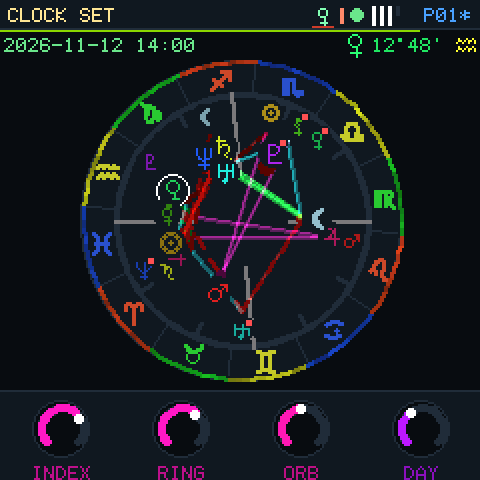
This is the real firmware (the same package the installer puts on your FM-1) running in an emulator. Click the screen, play keys, turn ALGORITHM to watch lines change on the wheel. Press GLO to set time and birth details, then SEQ for transits.
Open the emulator on its own page ↗ · It needs a fast computer. If the sound breaks up, that is the emulator struggling, not the FM-1.
New to ASTRA? Start here: the five-minute version. The full guide covers every knob, the astrology and the sound.
02 / THE ENGINE
The chart becomes the sound.
FM means tones bending other tones. ASTRA has ten, one for each planet from the Sun to Pluto, and plays four notes at once. On an ordinary FM synth you choose which tone bends which. Here your chart decides: it is the music of the spheres, made literal. How it works.
As far as we know, ASTRA is the first playable instrument built on personal astrology: it casts your birth chart on the device, and the aspects between the sky and your chart wire its FM engine.
Aspects are the wiring.
A conjunction bends hard, a trine smoothly, a sextile lightly; a square rings like metal; an opposition loops. The closer to exact, the stronger.
Your chart, the sky, or both.
The ALGORITHM knob takes the wiring from your birth chart, today's sky, or the two together, each twelve ways, or lets you wire it yourself.
Placement shapes tone.
A planet sounds like where it stands: its sign's element sets the wave, fire bright, water soft. Every value also has a knob.
The sky keeps moving.
Run the sky in real time, or up to five years a second, forwards or back, and hear the aspects form and fade. Planets swell as they return to their birth places.
A horoscope you can read.
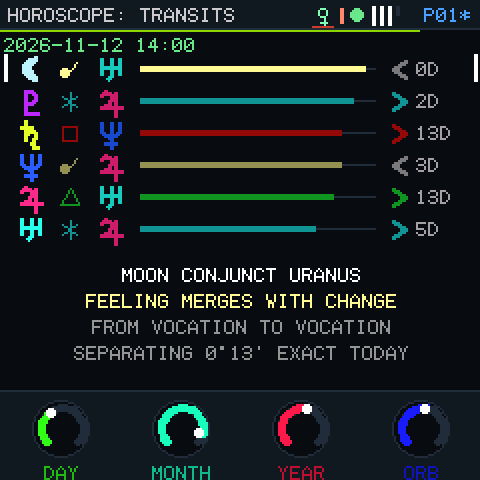
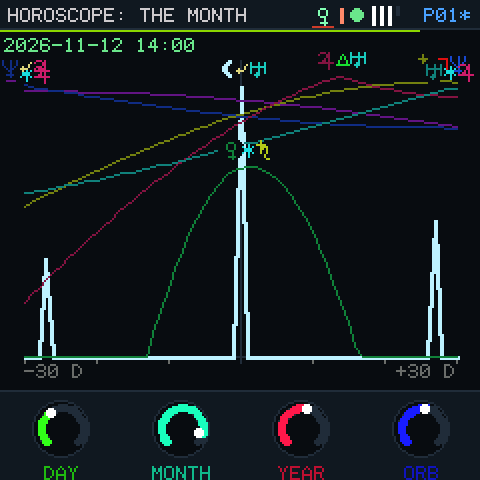
Today's transits to your chart, closest first, each read in plain words; the month around it; your birth chart; the Moon.
Effects and presets.
Chorus, echo and reverb. 64 preset slots: the ones you have not saved yet build their sounds from your chart.
03 / SCREENS
Every screen is line art.
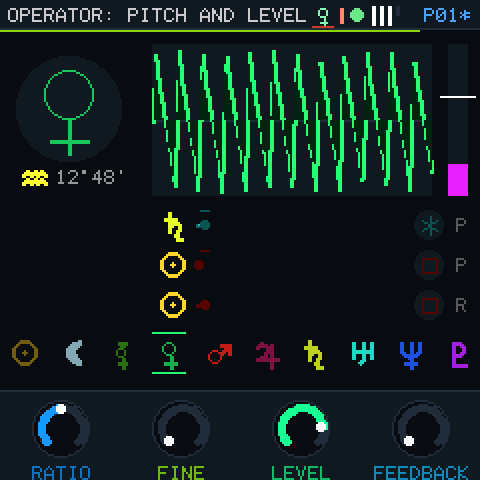
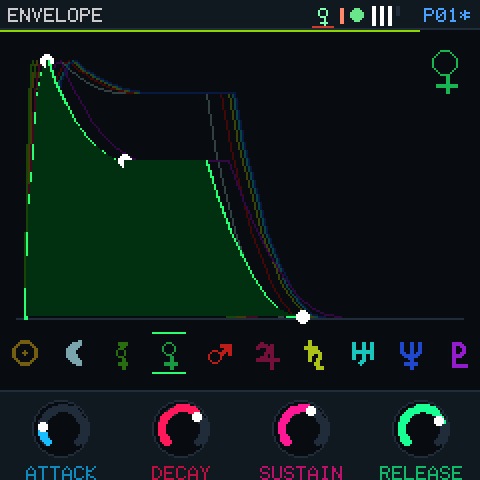
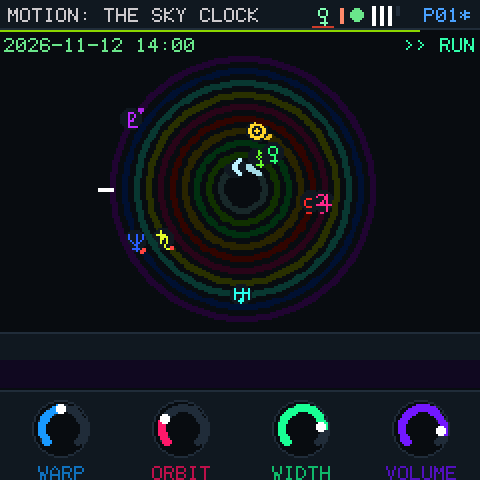
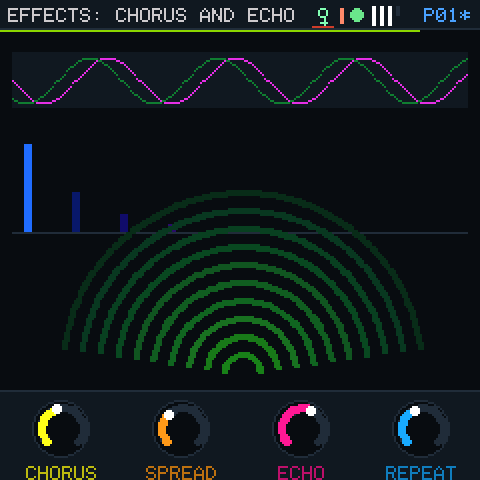
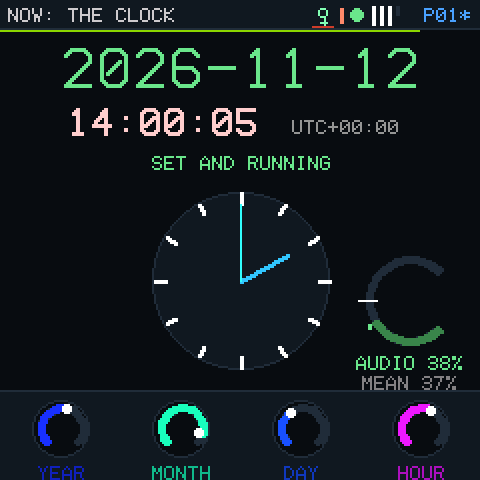
These pictures come from the real firmware running in the emulator. Every time you turn a knob, a colour changes somewhere on the screen to show the effect.
04 / CONTROLS
New jobs for old buttons.
The buttons keep the names M-VAVE printed on them, but ASTRA gives most of them new jobs. The four knobs in a row change job on every page, and the screen labels each one. These two tables say what everything does.
The buttons
| Button | What it does in ASTRA |
|---|---|
| HOME | Go to the wheel, the main page |
| EDIT | Shape the selected planet's tone (four pages) |
| ENV | How the selected planet's notes start and fade |
| LFO | The sky clock speed, plus vibrato and tremolo (two pages) |
| FX | Chorus, echo and reverb (two pages) |
| SEQ | The horoscope, four pages (ASTRA has no sequencer) |
| GLO | The clock, your birth details, chart settings (four pages) |
| PLAY | Pause or restart the moving sky; on the clock page, confirms the time shown is now |
| REC | Brings the sky back to the present; on the birth pages, builds a new sound from your chart |
| SAVE | Press once and the screen asks, press again to save the sound to its slot |
| SEL | Mute or unmute the selected planet |
| ARP | Latch: notes keep sounding after you let go; press the key again to stop it |
| OCT- | Keyboard down an octave |
| OCT+ | Keyboard up an octave |
The four knobs, page by page
| Page | Knob 1 | Knob 2 | Knob 3 | Knob 4 |
|---|---|---|---|---|
| HOME (The wheel) | INDEX: how hard every bend is | RING: how strong the metallic connections are | ORB: how wide an aspect may be and still count | DAY: move the sky a day at a time |
| EDIT 1 (Pitch and level) | RATIO: the planet's pitch relative to the note | FINE: fine tune adjustment | LEVEL: the selected planet's loudness | FEEDBACK: how much the planet's tone feeds on itself (grittier) |
| EDIT 2 (Tone) | WAVE: Air/Fire/Earth/Water sound shape | OUTPUT: how much you hear it directly | DETUNE: slight pitch shift | VELOCITY: how much playing harder matters |
| EDIT 3 (Free wires) | SOURCE A: which planet bends this one | DEPTH A: how strong that bend is | SOURCE B: second planet bending this one | DEPTH B: strength of second bend |
| EDIT 4 (Ring and keys) | RING SRC: source for ring modulation | RING: amount of metallic ring effect | KEYSCALE: quieter or brighter up the keyboard | MUTE: silence the selected planet |
| ENV (Envelope) | ATTACK: how fast a note starts | DECAY: how long it fades initially | SUSTAIN: level it holds while held | RELEASE: how long it takes to silence |
| LFO 1 (The sky clock) | WARP: how fast the sky moves (centre is real time) | ORBIT: how much planets swell at returns | WIDTH: stereo width | VOLUME: this sound's volume |
| LFO 2 (LFO and bend) | LFO RATE: speed of slow modulation | VIBRATO: pitch wobble amount | TREMOLO: volume wobble amount | BEND: range of pitch bend up to 12 semitones |
| FX 1 (Chorus and echo) | CHORUS: amount of chorus effect | SPREAD: width of the chorus | ECHO: time delay for the echo | REPEAT: how long the echoes keep coming back |
| FX 2 (Echo and room) | ECHO MIX: balance between dry and wet | SPACE: size of the reverb room | DAMP: make the reverb darker | REVERB: amount of reverb added |
| SEQ 1-4 (Horoscope) | DAY: move the sky a day | MONTH: move the sky a month | YEAR: move the sky a year | ORB: how close a transit must be to be listed (1-10 degrees) |
| GLO 1 (Now: clock) | YEAR: current year | MONTH: current month | DAY: current day | HOUR: current hour |
| GLO 2 (Birth: date) | YEAR: birth year | MONTH: birth month | DAY: birth day | HOUR: birth hour |
| GLO 3 (Birth: place) | LATITUDE: north is positive, in tenths of a degree | LONGITUDE: east is positive, in tenths of a degree | ZONE: birth time zone | TIME: known or unknown birth time |
| GLO 4 (Chart systems) | HOUSES: Placidus, Koch, Regiomontanus etc. | ZODIAC: tropical or sidereal system | ZONE: your local time zone for display | (not used) |
SELECT picks a planet (on the horoscope's first two pages, a transit; on the clock and birth-date pages, the minutes). ALGORITHM picks one of the 37 wirings. PRESETS picks one of the 64 sound slots. MASTER is the overall volume. EDIT and ENV always change the planet chosen with SELECT. More in the guide.
05 / THE SKY
The sky, computed offline.
The FM-1's own chip works out where the Sun, the Moon and the planets are, for any moment from 1800 to 2200. No network, no downloads, and your birth details never leave the device. The positions are accurate to a few arcseconds, far finer than any astrologer needs.
For the technically curious
The firmware's results in the emulator match the reference build bit for bit, and that build is checked against Astronomy Engine on 120 dates:
| Body | Method | Largest error, 120 dates 1800–2200 |
|---|---|---|
| Sun, Mercury … Neptune | Truncated VSOP87B, light time, aberration, precession, nutation | under 2″ |
| Pluto | Chebyshev fit of its barycentric orbit | under 5″ |
| Moon | Meeus ch. 47, the 34 largest terms | 38″ |
| Houses | Closed forms and iteration, checked against their geometric definitions | under 5″ |
The astrology is symbolic: the readings are keyword rules built on traditional meanings, not predictions. The FM-1 has no battery clock, so after a power-off the time is marked unconfirmed until you confirm it with PLAY.
VERSION 0.1 / INSTALL WITH CARE
Install with care.
Release 0.1, built and attested on GitHub: release page, attestations.
SHA-256 13ac51b0051d66f30a17670511d5477eeff9dcfa80ef6ab9f97126cd10004613
ASTRA is an early build, tested in the emulator and on a physical FM-1. Know the USB rescue before you install: hold OCT− while switching on. The installer needs Chrome or Edge and a USB data cable, and it can also take you back to the official firmware, V15.
WITH GRATITUDE
Built on generous work.
ASTRA runs on Dinghy by zvenson (GPL-3.0-only), whose base comes from Felucca by Leo Kuroshita (Hügelton Instruments) and SLOOP (isod89). The installer is Felucca's web installer. The emulator is fm1-emu by Joakim Eriksson (MIT). The planetary series are VSOP87 (Bretagnon and Francou) as truncated by Astronomy Engine (Don Cross, MIT), which also supplies the test references; the Moon and the calendar follow Jean Meeus's Astronomical Algorithms.
In good company. The idea is old: the music of the spheres, handed down from Pythagoras, and Kepler's Harmonices Mundi (1619). Willie Ruff and John Rodgers realized Kepler's planetary data as computer music in 1979 (The Harmony of the World). Martin Hollingham's Music of the Spheres sounds today's sky in the browser, aspects as intervals, with a planetary synthesizer of its own. ASTRA's part is the personal one: your chart, on the instrument, as the patch.